
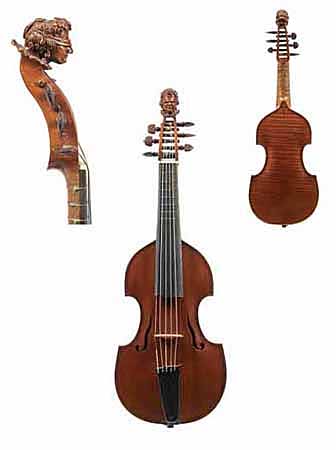
Owner: HWMC
Catalog#: 2CL-CHLT-116
Provenance: The Richard W. and Jeannine E. Abel Musical Instrument Collection
Violin Family
Viola d'Amore in 'Gamba Form'
Italy
European
Wood, gut strings, pearl, bone
ca. late 1700s – early 1800s
Length: 14.4 inches (Back)
Strings – Lutes – Violin Family
Viola d’Amore, unlabeled
The viola d’amore shares many features of the viol family, a bowed box-lute chordophone of Renaissance Europe.
This viola d’amore in “gamba form” is a smaller instrument of the gamba family. It is played on the arm (da braccio) rather than the leg (da gamba). It has six-bowed strings in contrast to seven or more and no sympathetic strings like the more famous and later versions of the viola d’amore. The sound holes are a special feature of the viola d’amore in gamba form. In contrast to the C-holes of the gamba and the F-holes of the violins, they are serpentine- or flame-shaped. The seven tied gut frets are another feature inherited from the viol family. An intricately carved head of a blindfold cupid with circular ruffled collar is at the top of the peg box, representing the blindness of love.
The origin of the viola d´amore is unknown, but the earliest mention of the name viola d´amore implies that these instruments had different tunings. Thus, the viola d´amore had no fixed tuning like the violin (fifths). The tuning chord was, especially in the 17th-18th centuries, based on the key of the piece.
Resource: https://omeka-s.grinnell.edu/s/MusicalInstruments/item/638