
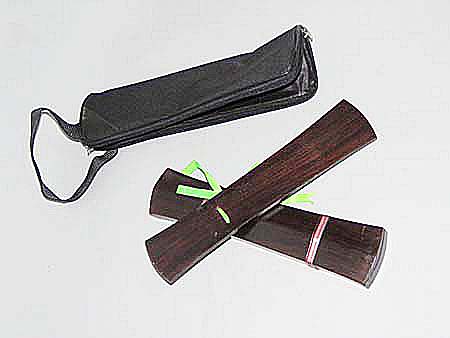
Owner: HWMC
Catalog#: 2AS-IDST-56
Clappers
Han Chinese 'Paiban' (Clappers)
China
Chinese
Rosewood, silk
20th century
Length: 10.75 in; Width 2.5 in; Depth: 1 in & .5 in
Idiophones – Struck Idiophones – Clappers
The Paiban (pai: ‘to beat’; bǎn: ‘flat board’) is a Han Chinese clapper of different types. It may also be referenced to as tánbǎn: ‘sandalwood clapper’; mùbǎn: ‘wooden clapper’; or shūbǎn. The paibǎn is made from several flat pieces of hardwood or bamboo, which is used in many different forms of Chinese music.
This set of paiban, known as the crotalo type, are made of rosewood, with two slats bound together on one end with wrappings of silk string and a third slat remaining separate. The double and single slats are loosely attached by a ribbon that is thread through the holes at the top. When played they are held vertically by the left hand with the connecting ribbon hung over the thumb separating the single slat from the double slats. Then with a rotating movement of the wrist, the sections are struck together producing a sharp clacking sound.
A single musician may play the paiban with the left hand and beat a small drum using a stick with the right hand. These two instruments are collectively referred to as guban. The guban (paiban and drum), are used in several genres of shuochang (Chinese story-singing), in Beijing opera, kunqu, and Yue opera. It is also used in instrumental music, such as Jiangnan sizhu, Chaozhou xianshi, Sunan chuida, nanguan, shifan luogu, and Shanxi batao.
Resource: ‘Paiban,’ Alan R. Thrasher, “The Gove Dictionary of Musical Instruments,” 2nd Ed. Vol 4., Laurence Libin, Editor in Chief. Oxford University Press.
Resource: https://en.wikipedia.org/wiki/Paib