
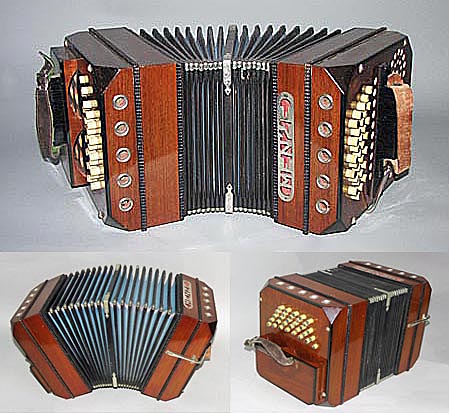
Owner: HWMC
Catalog#: LA-AEFR-01
Free Reeds
Menze 'Bandoneón' - popular in Latin America
Germany
Menze Manufacture
Wood, bone, metal, fiber
ca. 1960s
Length: 20 in; Width: 16 in
Wind Instruments – Free Reeds
Metal Label: “MENZE”
The square-built free reed button accordion or concertina was developed in the 1840s. Then, Heinrich Band (1821-1860), a cellist and proprietor of a music shop in Krefeld, Germany, marketed it under the name of ‘bandoneón’, honoring his surname. The instrument was most likely produced for him by Carl Friedrich Zimmerman (1817-1898) of Carlsfeld, Saxony Germany, a town where there were already several harmonium factories. These early models were diatonic and mainly intended to play chords, while playing a few notes on the push and pull of the bellows. This playing of pitches/notes is referred to as a bisonoric mechanism, meaning the same button produces different notes as the bellows are opening or closing.
Around 1864, the Arnold family started making bandoneóns, when Ernst Arnold (1828-1910) bought the Zimmerman factory and started building pieces under the E.L.A. (Ernest Ludwig Arnold) brand name. Next, Ernst Arnold and his son, Alfred Arnold started exporting the bandoneón to Argentina, where they were sold by Alberto Ohermann in the late 19th century. By the beginning of the 20th century they were sold in Argentina, Uruguay, and Brazil, where they became a solo virtuoso instrument in the tango orchestra.
By 1921, a chromatic model was introduced that allowed the musician to play a note without changing pitch when pushing or pulling the bellows.
The Menzel bandoneóns were manufactured in Germany, specifically in the Klingenthal and Markhausen regions of Saxony and Bohemia, respectively, where the Menzel family’s textile machinery business later established a second factory.
While the bandoneón is associated with Argentina, its origins and manufacture were rooted in Germany. This 62 button MENZE bandoneón is pictured in the Groves Dictionary of Musical Instruments, 2nd edition, Vol 1, pg. 216.