
Owner: HWMC
Catalog#: LA-AEWF-18
Provenance: The Natalie Wood collection of pre-Columbian ceramics from Chupícuaro, Guanajuato, México, at UCLA; Publisher: Los Angeles, Museum & Laboratories of Ethnic Arts & Technology, University of California
Edge Blown Flutes
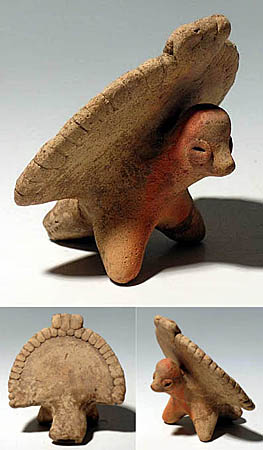
Mexico ‘Chupicuaro’ Avian Whistle
Guanajuato, North-Central Mexico
Chupicuaro Archeological Site/Culture
Terracotta
ca. 300 – 100 BC
Length: 4 in
Aerophones – Wind Instruments Proper – Edge Blown Flutes
A Chupicuaro avian (bird) whistle from West Mexico. Chupicuaro is a Prehispanic archeological site located in the north-central Mexican state of Guanajuato. This finely detailed instrument depicts an oscillated Turkey, a bird highly prized for its brilliant plumage, with his tail feathers spread into a large fan. It is intact with good mineral deposits, and a great tone on the whistle. You can find a picture of this Chupicuaro avian whistle in “The Natalie Wood Collection of Pre-Columbian Ceramics”, page 76.
According to Miami University Anthropology 3D Museum, the history of the Chupicuaro begins with the migration of humans into the modern-day Acámbaro area. Thus, Central Mexico was first settled in 8000 – 7000 BC. Nevertheless, pottery appears much later, around 2000 BC. The zenith of Chupicuaro society, during which the most monumental architecture was build and the most recognizable artifacts produced, lasted from approximately 400 – 100 BC (“Autoridades” 2). The reason for Chupícuaro’s decline is unclear.
Resource: https://anthropologymuseum.miamioh.edu/exhibits/show/chupicuaro_ceramics-of-west-me/history-overview