
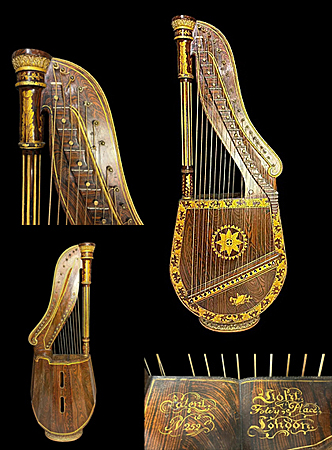
Owner: HWMC
Catalog#: 2CL-CHHP-06
Miscellaneous Harps - Harp Lute
Edward Light 'Harp-Lute' Dital Harp (B)
London, England
Edward Light, British, ca. 1747 – ca. 1832
Wood, lacquered and gilded
ca.1820 C.E.
Height: 35.25 in x Width: 13.5 in x Depth: 5 in
Strings – Miscellaneous Harps – Harp Lute
The gilded inscription reads: “Patent. / N 252/ Light. / Foley, Place / London.”
A rosewood Dital Harp (or chromatic harp-lute) by Edward Light(1747-1832) made in London circa 1820. This instrument has a pear-shaped body, with a curved neck supported by a front pillar or arm, reminiscent of the harp. There are eighteen strings and fancy gilt painted details in a foliage design.
Edward Light was an active inventor and composer who built the harp-lute around 1795 for vocal accompaniment, possibly to improve or replace the guitar. The defining feature of this harp-lute is a set of ‘ditals’ (small buttons) that players can press from the back side of the string neck, usually using the thumb, to raise a string’s pitch by a semitone. This mechanism, patented in 1816, allows for chromatic playing without needing to manually change levers or pedals. Just below the ‘ditals’ on this harp-lute is a very small fret board/neck.
Resource: https://en.wikisource.org/wiki/A_Dictionary_of_Music_and_Musicians/Dital_Harp