
Owner: HWMC
Catalog#: 2CL-AELV-71
Provenance: From the wind and brass collection of Kraftwerk multi-instrumentalist, Florian Schneider
Tubas / Sousaphones / Helicons
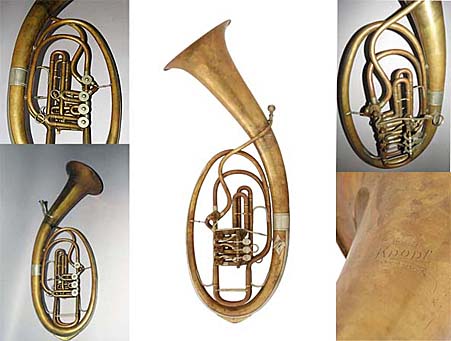
'Wagner Tuba’ - 4 Valves by Herbert Fritz Knopf
Markneukirchen, a town in Saxony, Germany
Herbert Fritz Knopf
Metal, Brass
ca. 1930s
Height: 33 in; Width: 14.25 in; Bell Diameter: 9.38 in
Wind Instruments – Brass Instruments – Tubas / Sousaphones / Helicons
Bell is engraved: “Herbert Fritz Knopf / Markneukirchen SA”
This 1930s Wagner tuba was made at the Knopf workshop in the town of Markneukirchen. It has four rotary valves, is made of brass, and has the original (French horn type) mouthpiece. Markneukirchen is a town in Saxony, Germany, located in the Vogtland district, near the Czech border. It is famously known as the “City of Music” or German center for musical instrument making.
The Wagner tuba was first conceived by composer Richard Wagner (1813-1883) in the summer of 1853 for his four-part opera cycle, Der Ring des Nibelungen, which was based on Nordic mythology. Wagner wanted to bridge the sounds of the French horn and trombone with this instrument. Though designated as a ‘tuba,’ it is more akin to the French horn and tenor horn (trombone). At the actual premiere of Das Rheingold, on September 22, 1869, they did not employ the new instrument, and we are not certain it had been made or realized yet.
According to http/wagner-tuba.com, the very first Wagner tubas were made in 1874-75 by the Munich craftsman Georg Ottensteiner, who trained in Paris and offered his own line of Sax-type brass instruments. Then in 1877 C.W. Moritz of Berlin, delivered a quartet of what they called ‘horn tubas,’ which they claimed to be the first original Wagner tubas.
This 1930s Wagner Tuba is a hybrid of horn and tuba developed for Wagner’s operas, that were actively used and built during that era, often by makers like Knopf. These hybrid horns blended the horn’s tone with the tuba’s power, featuring 4 valves. They were played by horn players to add a distinct, mellow, yet focused voice to orchestral textures, bridging the gap between horns and trombones,
In the 1960s there were major changes for the Wagner tuba by various manufacturers including Gebr. Alexander in Mainz, Germany, as leading composers chose to give the instrument a significant role in important works.
Resource: https://www.wagner-tuba.com/wagner-tuba/