
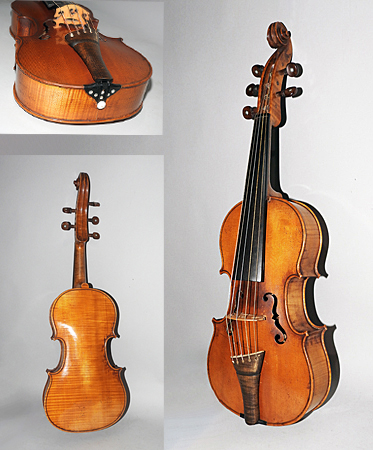
Owner: HWMC
Catalog#: 2CL-CHLT-002
Violin Family
'Viola d'Amore' - Mirecourt France
Mirecourt, France
Wood, mother-of-pearl, gut & metal strings
ca. Late 19th century – Early 20th century
Length 26.75 in; Width: 8.38 in; Depth: 2.44 in; Body Length: 14 in
Strings – Lutes – Violin Family
This viola d’amore is possibly from Mirecourt, France. It has an extremely long and thin peg box with five rosewood pegs. Each of the pegs has a six-pointed mother-of-pearl inlay. Originally there were six peg head holes, and one has now been filled, and an angular tailpiece has been added to accommodate the five strings instead of the original 6 strings. Having five-strings, the performer now has the powerful C string of the viola while maintaining the ease of the violin’s upper register on the E string. There are no sympathetic strings.
The acoustic sound holes are a feature of the viola d’amore in contrast to the ‘C’ of the gamba and the “F” holes of the violin. Here we see stylized flame-shaped sound holes. The bottom of the viola d’amore also has six mother-of-pearl circle inlays. The ribs are curly maple, with a single piece maple back.
The earliest accounts of the viola d’amore dates back to mid-17th century in England and Germany. These metal strung instruments looked like viols but did not feature sympathetic strings. It was not until the late 17th century that makers started adding a set of sympathetic vibrating strings beneath the top playing strings and under the finger board, which became the norm.
The ‘classical’ time for the viola d’amore was during the 2nd half of the 18th century, with composers Giovanni Toeschi (1735-1800), Johann Georg Albrechtsberger (1736-1809), Friedrich Wilhem Rust (1739-1796), Carl Stamitz (1745-1801) and Bohemian composers. Since then, the interest in the viola d’amore has been a continuous wave with declines and surges. Today as new works are being created, we see a rising interest in old instruments generally and a growing taste for exotic sounds.
Resource: https://www.violadamoresociety.org/en/viola-damore/about-the-viola-damore.