
Owner: HWMC
Catalog#: 2CL-CHLT-210
Mandolins
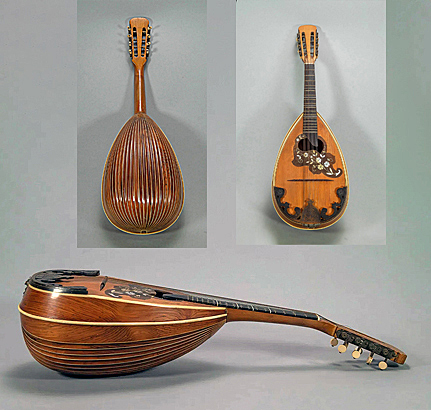
Neapolitan 'Mandolin' with Fluted Bowl-back
Possibly Cremona, Italy
No Label
Woods, mother-of-pearl, metal
ca. Late 1800s – Early 1900s
Height: 23 in; Width: 8 in; Depth: 5.5 in
Strings – Lutes – Mandolins
No Label/Markings
A beautiful Neapolitan fluted bowl-back mandolin with a Brazilian rosewood body and solid spruce top. It has a floating bridge which means that the strings flow past the bridge and end at the base of the instrument where they are fixed to a tail piece. A figurative wood carved piece covers the top of the bottom portion of the instrument and tail piece, and the center sound hole is decorated with flowers made in Mother-of Pearl. The top has a slight incline from the bridge downwards to the end and the supporting sides are trimmed with ivory. There are 17 metal frets. The double strings are tuned to the same note to increase the volume and projection of the instrument, using eight individual tuning pegs with ivory peg heads. The mandolin four double course strings are tuned in an interval of the perfect fifth, the same tuning as a violin (G3, D4, A4, E5).
The Vinaccia family of Luthiers invented this form of mandolin in the 18th century. Due to its popularity, it became known as the Neapolitan Mandolin, named after the city. The word mandolin means ‘small mandola’, which is a fretted instrument.
Resource: www. Mandolin: Overview, History, Mechanism, Types & Famous Players