
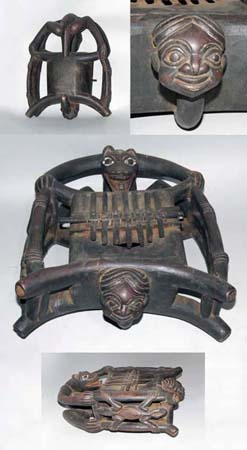
Owner: HWMC
Catalog#: 2AF-IDPL-26
Lamellophone - Plucked
Bamum 'Mbira' - Lamellophone
Cameroon, Grassfields Region
Bamum
Wood, pigment
Early 20th century
Length: 19 in; Width 13.5 in; Depth: 7.5 in
Idiophone – Plucked
The mbira is a traditional African lamellaphone — a wooden board with wooden/metal tines — played by plucking the tines with the thumbs and fingers. In Bamum culture, it is part of a wider family of lamellophones/ thumb pianos found across Central Africa, primarily located in Cameroon and specifically in the western highlands known as the Grassfields region. Seen here is a mbira with seven wooden tines, and a hallow curved bottom resonator board. Special made Bamum mbiras may appear in diverse forms, sometimes with symbolic carvings and ancestral motifs as seen here.
On top of this mbira is a lizard motif with both eyes accentuated in white pigment. On both sides are carved two more lizard motifs, possibly serving as a visual warning to onlookers that the ruling authorities are watching and ever present, protecting the Bamum female head seen below. At the bottom is a stylized Bamum carved female head in the likeness of the ‘ngoin,’ a female helmet mask. The ‘ngoin’ female helmet masks represent a royal wife and are a symbol of ideal womanhood. These female helmet masks called ‘ngoin’ are worn atop the head, not over the face.
According to several proposed theories, the thumb piano appeared twice in Africa. Once on the west coast about 3,000 years ago (with bamboo or wood slats) and a second time in the Zambezi Valley about 1,300 years ago (with metal slats.)
While the term kalimba became popular in the 20th century through ethnomusicologist Hugh Tracey’s work, the Bamum and other Grassfields people have long used the name mbira. This reflects the fact that “mbira” is a Bantu term for a class of finger pianos in the Grassfields Region, specifically denoting the instrument’s tradition.
Reference: https://instrumentoinusual.net/historia-y-evolucion/kalimba-dedos-danzan-metal-transmision-cultura-africana/