
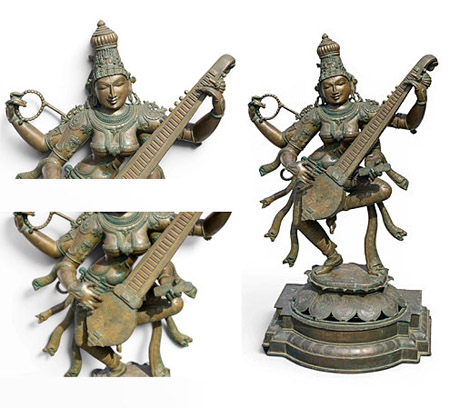
Owner: HWMC
Catalog#: 2AS-OTHER-55
Ritual Symbolism
Hindu Goddess ‘Saraswati' Statue
India
Hinduism
Bronze
1800’s or Earlier
Height: 48 in, Width: 33 in; Depth: 18 in
Other: Ritual Symbolism
In classical and medieval Hinduism, Saraswati is primarily recognized as the Goddess of learning, arts and poetic inspiration, and as the inventor of the Sanskrit language.
This vintage bronze statue of Saraswati is portrayed as a serene woman with a nice smile, representing the quality of sattva (goodness). She has four arms, each holding a symbolic object: a musical instrument known as the veena using both front right and left hands to play the instrument; an akshamala (prayer beads) in the back right hand; and the Vedas (scriptures) in the back left hand. She is standing on a lotus (padma), which symbolizes purity, enlightenment, and the absolute truth of knowledge.
Of these symbolic objects, the veena represents harmony, intelligence, creativity and the beauty of the fine arts. Playing this instrument symbolizes tuning the mind and intellect to align with universal truth. It also shows the beauty of learning the fine arts.
The akshamala (prayer beads), held by the back right hand signifies all spiritual discipline meditation and japa (chanting sacred names of God). Japa is believed to be more important than the secular knowledge contained in the pustaka (book)/ the Vedas (scriptures) she holds in her back left hand, represents sacred knowledge.
Saraswati’s four arms represent her unrestricted power in the four directions, as she also represents creativity, or the combination of power and intelligence, the basis of creativity.
Saraswati continues to be widely worshipped across India, particularly on her designated festival day, Vasant Panchami (the fifth day of spring and known as Saraswati Puja and Saraswati Jayanti in many regions of India), when students honor her as the patron goddess of knowledge and education. Traditionally, the day is marked by helping young children to write their first words, and study or create music together.
Resource: https://www.stephen-knapp.com/ and Sirlu Kuppa