
Owner: HWMC
Catalog#: 2AS-CHHP-03
Harps
Burmese 'Flying Dragon' Harp
Myanmar (Burma)
Burmese
Wood, gold gilt, silk, cotton, mirrored glass, deer skin
ca. 19th century
Instrument Length: 41 in; Width: 10 in; Height: 27in
Stand: Height: 10in; Width: 9.5 in; Depth: 11 in
Chordophones – Harps
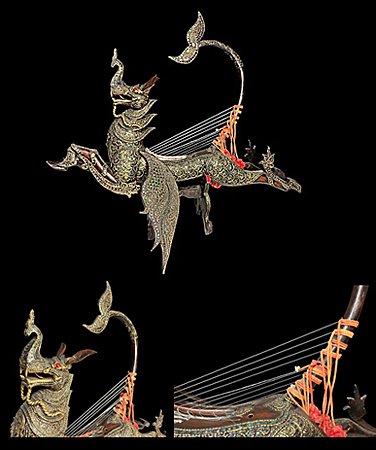
This Flying Dragon is from Burma resembling the “Saùng-Gauk” harp. In Buddhism, a flying dragon is a powerful symbol of wisdom, protection, and transformation, representing a sacred, benevolent being rather than a monster. These celestial creatures are seen as guardians of Buddhist teachings, associated with creative power, and can transform at will. The flying dragon also symbolizes spiritual growth and serves as a guide for inner strength.
In Burma, Buddhism was introduced through trade relations with India. While there is no single instrument in Buddhism officially named the “flying dragon harp,” several historical and cultural connections link dragons and harp-like instruments. An example is the Yazh (or Yaazh), an ancient, harp-like string instrument central to Tamil music and culture, referenced in Sangam literature for over 2,000 years. It is known for its ethereal sound and arched frame (often with a mythological creature’s head like a Yali). The instrument became obsolete in India by the medieval era with the rise of veena-like instruments.
This Burmese harp, similar to the ‘”Saùng-Gauk” harp’ is in the shape of the Burmese creature called a ‘Pyinsarupa’ and is an important cultural symbol in Myanmar (Burma). The ‘Pyinsarupa’ is a chimeric animal from Burmese mythology, meaning an amalgamation of the physical characteristics of five different animals, symbolizing a combination of land, water, and winged creatures. The components of this ‘Pyinsarupa’ consist of the Elephant (trunk); Bullock/Water Buffalo (body); Horse (legs and ears); White Carp/Nga Gyin Fish (tail and scales); and Hamsa (wings). The ‘Pyinsarupa’ is fully decorated with pieces of mica (Mandalay pearls’), glass, and gilt. The ends of the strings on the harp are decorated with red cotton tassels. There are nine strings that angle upwards from the string bar to the string bindings on the lower part of the curved arch of the tail. This harp rests on a padded decorative custom stand.
This creature is commonly featured in traditional Burmese hsaing waing traditional orchestras and served as the logo of Myanmar’s flagship air carrier, Myanmar Airways International.
Resource: “Saung-gauk,” Muriel C. Williamson, Gavin Douglas, John Okell, “The Grove Dictionary of Musical Instruments,” 2nd ed., Vol. 4, Laurence Liben, Editor in Chief. Oxford University Press