
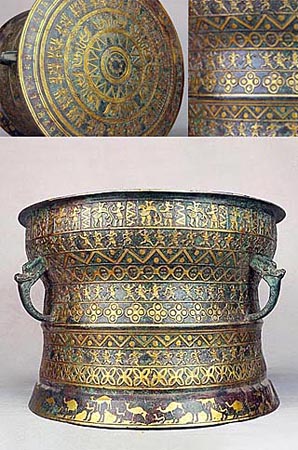
Owner: HWMC
Catalog#: 2AS-IDST-95
Struck Idiophones
China 'Eastern Han Dynasty' Bronze (War) Drum w/Cou Gold
China
Han Dynasty
Bronze, gold
ca. 220 C.E.
Height: 13.5 in; Width; 20.8 in; Weight: 38.2 lbs
Idiophones – Struck Idiophones – Gong
This bronze drum with cuo gold trim is an artifact from the ancient Eastern Han Dynasty (25 C.E.-220 C.E.). The Han dynasty was an imperial dynasty of China, which is divided into two major periods: the Western or Former Han (206 B.C.E.–9 C.E.) and the Eastern or Later Han (25–220 C.E.). After the civil war that followed the death of Qin Shi Huang in 210 B.C.E., the Qin state, wanting to create a unified country with a central power and a large military, carried out a series of swift conquests. Following a brief warring period, the rebel leader Liu Bang gained power and founded the later Han Dynasty.
This Han period is considered a golden age in Chinese history and to this day, China’s majority ethnic group refers to themselves as the “Han Chinese” and the Chinese script is referred to as “Han characters”.
The Eastern Han Dynasty (25 C.E. – 220 C.E.) saw an age of economic prosperity and growth. Military campaigns expanded Han control into Central Asia and helped establish the trade network known as the Silk Road, which reached as far as the Mediterranean world. The events of this time period are reflected in this drum, with numerous solders battling, the traveling camels on the bottom and the added wealth of gold.
Featured is the gold inlay applied using a technique known as cuo jin (错金). These drums, used for ceremony, ritual, and warfare, were symbols of wealth and power. The term cuo refers to the method of inlaying gold and silver into a bronze or iron base. When both metals are used, this technique is called cuo jinyin. The three serpent handles are covered in green patina, a layer of corrosion that develops over time due to exposure to the elements.