
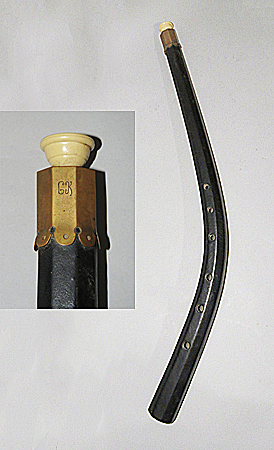
Owner: HWMC
Catalog # CL-AELV-199
Cornetti - Serpents - Ophicleides
'Zink' (Cornetto) in 'A'
Germany
Unknown
Wood, leather, metal, ivory
ca. 1800s CE
Tube Length: 24.75 in
Wind Instruments – Brasswinds – Cornetto
Hand engraved on brass: GK
The cornett (Italian: cornetto, German: Zink) is a lip-reed wind instrument that was popular from 1500 to 1670. The cornetto is Italian and means “small horn.”
This is most likely known as a Germany ‘Zink’ as it has an ivory cup mouthpiece with a metal ferrule at the mouthpiece receiver, a feature found in the cornett from Germany. The lack of diamond carvings also hints at a German origin. It is a curved cornetto/zink built in the treble size of 24.75 inches in length. It has an octagonal body with a conical bore, narrow at the mouthpiece and widening towards the bell. There are six finger holes and a single thumb hole on the opposite side. Together these allow the instrument to play a diatonic scale.
This cornetto/zink is made of wood and covered tightly in leather to prevent air leakage. It is slightly curved much like curved animal horns that were turned into signal horns, but unlike animal horns there is an opening at the end of the tube, rather than placing an opening on the side of an animal horn. Because of the six finger holes and one thumb hole, it is considered today to be a combination of brass and woodwind instruments.
At the beginning of the 17th century there were two virtuoso instruments, they were the viol and the cornetto. These two instruments shared the center stage and written music from the Renaissance to the Early Baroque, then the viol developed into the violin family and became the most popular.
Resources: https://en.wikipedia.org/wiki/Cornett
https://www.metmuseum.org/it/art/collection/search/503951
https://emuseum.nmmusd.org/objects/14198/curved-cornetto?ctx=ec3109d69f7ddd3933a40c2e59c0fe9cb77 ca810&idx=2