
Owner: HWMC
Catalog#: 2CL-CHHP-02
Harps
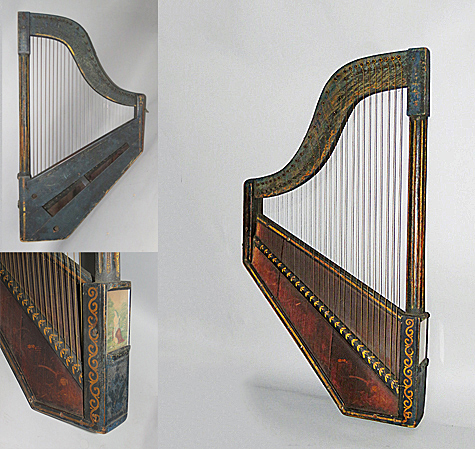
'Harp Celeste' of the 19th century
St. Louis, MO
Adam Shattinger (possible dealer)
Wood, metal, gilded gold and polychrome
ca. 19th century
Height 34 in; Width: 19 in; Depth: 3 in
Strings – Harps (Zither plucked)
Engraved in harp: Illegible/possibly A. Shattinger
An early harp celeste of the 19th century. The word ‘celeste’ is a female given name, originating from the Latin word “caelestis,” meaning heavenly or of the sky. Associated with celestial bodies and the heavens, it conveys a sense of ethereal beauty and timelessness. This is not to be confused with ‘celesta,’ a keyboard instrument.
Blue and gold leaf vine painting is throughout with a framed painted picture of a girl playing a lyre-harp at the bottom of the front pillar. The inscription inside is illegible. There are (28) twenty-eight metal strings, although it had been restrung. The only other harp celeste that I could fine was in the Metropolitan Museum of Art in New York City that shows the maker as ‘A. Shattinger’ from St. Louis, Missouri, 1900s. The harp celeste shown on this website has an opening for the resonator in the back rather than a hole in the front, a framed oil painting, and the pillar is straight with gold painted indent strips.
Possibly: Adam Shattinger (Music Store)
Adam Shattinger was a significant figure in the St. Louis music history, establishing the prominent Shattinger Piano & Music store at 910 Olive street in 1876. He and his wife, Marie Kunkel, a sister of Charles Kunkel, a well-known musician, and children (Adam, Charles, and Mignon) lived at 2738 Utah Street. Adam was born in Bavaria and came to this country in 1848 and to this city in 1852. He was a member of the Legion of Honor, Royal Arcanum and Royal League. Upon the death of Adam (72 yrs old) in 1876, his son, Oliver, took control of the business. It became a central hub for musicians, connected to prominent local music groups like the Apollo Club and was a central point for music publishing and retail in St. Louis for decades. While the Shattinger Store had been prominent in all branches of the musical business as it developed, it began to give less attention to the sale of pianos. Thus, the bulk of the store during Adam’s term was printed music, as the firm owned many copyrights and was doing considerable business in grade music and high standard publications.
After many years of management by the founding family the retail sheet music store was then sold to William Shaw in 1948. Finally, in 2000 two longtime employees, James Cochran and Linda Bagsby, bought the business. The business eventually faced financial troubles, leading to a fundraising effort around 2012-2013 before closing. Nevertheless, the Shattinger legacy lives on today through music archives and historical mentions.
In essence, Adam Shattinger was a foundational figure in the St. Louis music world through his long-running music store, leaving a mark on the city’s musical heritage.
Resource: Music Trade Review -mbsi.org, arcade-museum.com–digitized with support from namm.org, pg 36.