
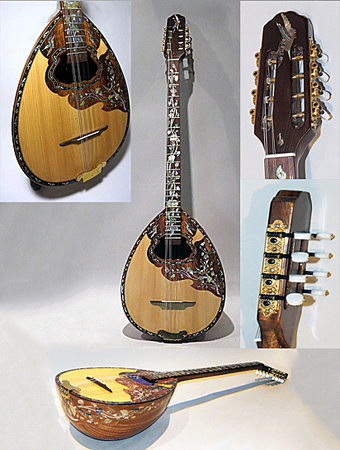
Owner: HWMC
Catalog#: 2CL-CHLT-010
Miscellaneous Lutes
Greek 'Bouzouki' Tetrachord -(B)
Greece
Unknown craftsman
Rosewood, spruce, mother-of-pearl, celluloid, metal
Mid-Late 20th century
Length: 38 in, Width: 11.5 in, Depth: 6 in
Strings – Lutes – Miscellaneous Lutes
This four-course bouzouki (tetrachordo) is the most common bouzouki used in Greek music today. It has a bowl-shaped rosewood body with a spruce top and a mahogany neck. There are 24 metal frets and 8 metal strings arranged in 4 pairs, known as courses, typically tuned C3C4–F3F4–A3A3–D4D4 (i.e., one whole step below the four high strings of a guitar).
Floral inlaid patterns of MOP decorate the neck throughout. On the resonator top is floral inlaid of MOP that extends around the bottom on the back. This MOP design is also on the outside of the top, around the sound hole and extends to serve as a pick gourd. In addition to floral patterns, hummingbirds are also depicted drinking from the flowers with wings extended. The strings are held at the bottom with a curved gold metal tailpiece.
The Greek bouzouki is a plucked lute and comes from the tambouras family, that first existed in ancient Greece as the ‘pandura’ which can be found in various sizes, shapes, and with different numbers of strings. During the Byzantine times (330 CE to 1453 CE), it was first called pandoura and then tambouras.
The bouzoukia first arrived as a three course (six strings in three pairs, known as trichordo) following the 1919-1922 war in Asia Minor resulting from the subsequent population exchange between Greece and Turkey. At the end of the 1950s, the four-course (tetrachordo) bouzouki (seen here) began gaining popularity.
Resource: National_Historical_Museum,_Athens