
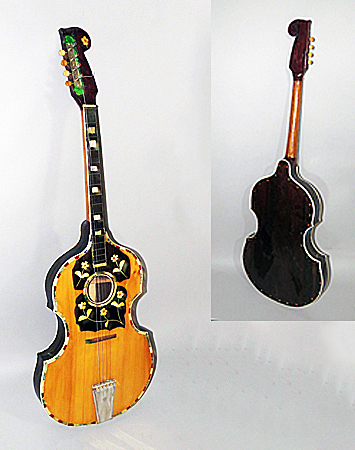
Owner: HWMC
Catalog#: 2CL-CHLT-169
Miscellaneous Lutes
Croatian ‘Tamburica – Celo' Selinshick
Pittsburgh, Pennsylvania
George J. Selinshick
Wood, leather, mother-of-pearl, metal strings
Mid 20th century
Height: 40 in; Width: 13.5 in; Depth: 3.25 in
Strings – Lutes – Miscellaneous Lutes
Written inside on wood: Made by G.l. Selinshick /N.S. Pgh Pa
East Europe has quite a few long neck lutes; a lot of them called tambura (or tamboura). Originally, they are based on instruments from southern parts of Europe, like the Turkish saz, or the Albanian cifteli or the sargija. The body used to be pear-shaped, but more recently the guitar-shape is getting more popular. Over time it has evolved to become the Croatian and north Serbian national instrument.
In places like Bulgaria and Macedonia, the tamburas are the only plucked instrument played in a group. However, in Serbia and Croatia they have groups (tamburitza) playing solely plucked instruments – of different sizes, expanding into a whole family known as the tamburitza orchestras.
The basic tamburicas are from the smallest to the largest: bisernica, brac, bugarija, celo and berde. The tamburitza group may have just one of each, or several close to the same size and they may also be tuned differently. The tamburica is plucked or strummed by hand or with a plectrum.
This is one of several tamburicas in this collection made by tambura maker George Selinshick (1894 – 1979) from Pittsburgh PA. It is called ‘Celo’ or ‘Celovic,’ and is the guitar-like bass instrument in the tamburitza orchestra, playing the bass lines/counter melodies. The four thick metal strings are usually played with a thick plectrum. On top of the resonator is a round hole that is ornately decorated with darker wood and MOP flowers with leaf stems. The instrument is finely trimmed around the front and back edges with MOP. There are four ivoroid pegs on the left side of the peghead and blocks of MOP on the neck between some of the metal frets.
Resource: https://www.atlasofpluckedinstruments.com/europe2.htm