

Owner: HWMC
Catalog#: 2CL-CHLT-40
Provenance: Robert Massaro Collection, Florida
Violin Family
'Viol da Braccio' - Renaissance Model - Viola
Italy
Unknown
Woods, metal & gut strings, bone
Mid 20th century
Length: 25.5 in, Width: 9.5 in, Rib width: 4 in, Depth: 1.75 in
Strings – Lutes – Violin Family
The violin family has had a fascinating journey through the centuries marked by the evolution of bowed string instruments. They originated in Italy in the 16th century from medieval instruments such as the vihuela and the viol da braccio.
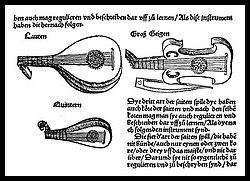
This fiddle is a Viol da Braccio (Italian for ‘arm viola’), that was modeled after a plate from a treatise by Sebastian Virdung in 1511, showing the lute family—plucked and bowed. This is the first printed illustration of a viol in history.
The model viol displayed here is very similar in shape to the printed illustration. It has 3 strings; two ‘C’ sound openings and a circular opening in the top of the acoustical resonator; and a carved dragon head instead of a back slant for the peg head. However, there are no frets (bunde) as shown in the printed illustration. The model body is a hollowed piece of poplar wood covered by a spruce top.
The early form of three-string violas changed to a four-string version and developed with tuning in fifths. At first “da braccio” seemed to encompass the entire violin family. However, it came to be reserved for the alto member, the viola, as there were also changes in sizes and tunings that evolved into the violin (soprano), viola (alto), and cello (tenor). The double bass, however, developed from both the violone and the bass-viola da gamba.
Resource: https://vichy-encheres.com/2022/05/09/viola-da-braccio/
Resource: Cultural Heritage Digitisation Service – Edinburgh University Library