
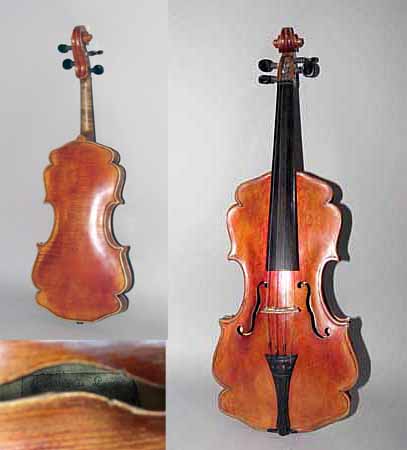
Owner: HWMC
Catalog#: 2CL-CHLT-203
Violin Family
Viola d'Amore - 'Transitional 4-String'
Italy
Unknown
Wood, metal strings
ca. 19th century
Back Length: 14 in; Total length: 23 in; Width: 8 in.
Strings – Lutes – Violin Family
Inside Label: Camillus de Camilli / Fecit in Manjova 1761
Main Bridge signed: Beardon Buckley
This ‘transitional 4-string’ viola d’amore with a festooned body (graceful, curved form), is typically referred to as an early Baroque or pre-Baroque string instrument that bridged the gap between Renaissance viols and the standardized modern violin family. While true viola d’amores (Italian for “viol of love”) are known for having 14 to 12 strings (7 to 6 bowed and 7 to 6 sympathetic), some early makers of the violin/viola experimented with stripped-down 4-string designs to create a more portable, expressive voice. This transitional or folk version that stripped away the sympathetic string mechanism, became the predecessor to the modern violin or standard viola.
While this ‘transitional’ 4-string’ viola d’amore shows a label signature of the refined and prolific violin maker Camillus de Camilli (c. 1703 to 1754), its date of 1761 makes it impossible to be made by Camilli. The 1761 label are sometimes seen on violins produced in Germany and France during the late 18th century, however, the 19th or 20th century artist customized made replicas are more highly valued.
Characteristics of this ‘transitional 4-string’ viola d’amore include a hard, clear orange-red finish, high arches and the positioning of the F-sound holes that are fluted and conform with Cremonese construction principles. The back is formed by two pieces of curly maple, and the front is of Italian spruce.
Resource: https://www.violadamoresociety.org/en/viola-damore/about-the-viola-damore