
Owner: HWMC
Catalog#: 2CL-CHLT-198
Violin Family
Viola d'Amore - Alfred Coletti
Vienna, Austria
Alfred Coletti
Wood, metal strings
ca. 1926
Back Length: 14.75 in; Total length: 32.25 in; Width: 9.38 in; Depth: 2.2 in
Strings – Lutes – Violin Family
Viola d’amore, inside label: Alfred Coletti. / k.u.k. hof – Geigenmacher / in Wien. / Anno 22. Mai 1926.
Maker’s mark etched 3 places into outside wood: (Logo) / A.G. COLETTI
Main Bridge: etched *A (tree logo) M*
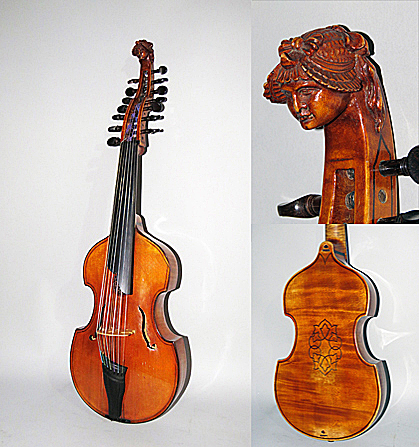
A viola d’amore made by Alfred Coletti (1878–c.1929) from Vienna, Austria. Coletti was a pupil of Carl Hermann Voigt from 1892-1904. In 1904, he joined the firm of Hamberger and took over the workshop the following year. A renowned Viennese luthier and restorer, Coletti was often called the “Viennese Stradivari”. He became official violin maker of the Viennese court by 1906, where he was responsible for the large collection of ancient stringed instruments. His own original works (including this viola d’ amore) were highly finished, utilizing reclaimed 16th-century timber from local sites, and were well covered with deep orange varnish.
The viola d’amore, or viola “of love,” shares many features of the viol family, a bowed box-lute chordophone of Renaissance Europe. Like all viols, this viola d’amore has a flat back and a rosette in addition to sound holes. The sound-holes are in the shape of a flaming sword known as “The Flaming Sword of Islam” (suggesting the instrument’s development was influenced by the Islamic World). These sound holes were one of the three usual shapes for viols as well.
Characteristics of the eighteenth century style viola d’amore are the seven sympathetic strings behind the seven main strings and fingerboard, which are not directly played, but vibrate ‘in sympathy.’ The first unambiguous reference to a viola d’amore with sympathetic strings, does not occur until the 1730s.
An intricately carved head of a women with a bonnet/hat is at the top of the peg box. This viola d’amore is unfretted and played much like a violin, being held horizontally under the chin. It became a particularly popular string instrument and could be found in the eighteenth-century works of Baroque composers such as J.S. Bach, G.P. Telemann, and Antonio Vivaldi.
Resource: https://en.wikipedia.org/wiki/Viola_d%27amore